JCP Technology to Market · since 1986

For research consortia

Impact, dissemination and exploitation for research projects

JCP helps research and innovation teams connect project results with the organisations that can use them. We contribute market and user evidence before submission, structured communication and dissemination during the project, and practical routes to adoption, licensing, pilots and follow-up collaboration.

Horizon Europe · Digital Europe · Eurostars · Interreg · Innosuisse

Impact pathway

  1. Research resultWhat the project develops
  2. Target groups, evidencedInterviews, needs, barriers, letters of interest
  3. Dissemination and outreachTo the organisations that could adopt the results
  4. UptakePilots, licences, follow-up projects, products

Directly relevant experience: research communication for MaNEP, commercialisation support for the University of Geneva spin-off PHASIS, software delivery for EPFL with a development partner in Slovakia, and long-term industrial business development since 2006. See relevant experience →

Services by project phase

Before submission, during the project, towards uptake

Fees are agreed in writing before work begins. Proposal-development consultancy is not charged to a future grant.

Phase 1 · Before submission

Impact evidence sprint

For coordinators, companies and start-ups preparing a Horizon Europe, EIC, Eurostars or Innosuisse application.

  • Define target groups and the change expected for each
  • Interview potential users, buyers, adopters or multipliers
  • Document current alternatives, needs and adoption barriers
  • Obtain letters of interest only from organisations that have reviewed a specific proposition
  • Draft a contribution to the impact pathway and to the dissemination and exploitation measures
  • Identify ownership, IP, regulatory and standardisation questions for the appropriate specialists
Lead time
3–6 weeks before the deadline
Deliverable
Evidence file, target-group map, interview synthesis, letters of interest obtained and a proposal-ready contribution. Funding is never promised.
Phase 2 · During the project

Communication, dissemination and exploitation work package

As a supplier to a funded project, or as a participant with a bounded task where the consortium and call justify it.

  • Stakeholder map segmented by influence, need and route to uptake
  • Communication and dissemination plan with messages, channels, responsibilities, budget and measurable indicators, updated periodically
  • Project identity, website and editorial production where required
  • Key exploitable results register: owner, maturity, dependencies, protection route, target users and next decision
  • Periodic exploitation workshops aligned with technical progress
  • Industrial outreach, clustering and matchmaking with relevant companies, projects, networks and public bodies
  • Policy, standardisation or procurement pathways where the results require them
  • Accessible, multilingual communication for defined user groups
Duration
Project lifetime, typically 3–4 years
Deliverable
A maintained evidence trail showing who was reached, what they need, which results are ready for which route, and what decision comes next.
Phase 3 · Towards uptake and continuity

Result validation and uptake plan

For projects that have a result and need to know where it can be used, by whom, and under which conditions.

  • Test priority applications with potential adopters
  • Rank pilot, licensing, procurement, spin-off, service and follow-up-project routes
  • Define the next owner, budget and milestone for each selected route
  • Prepare an adoption package for the organisations that will continue after the project ends
Duration
6–10 weeks
Deliverable
A route-to-use plan for each priority result, with evidence, owner, next decision and continuity action.

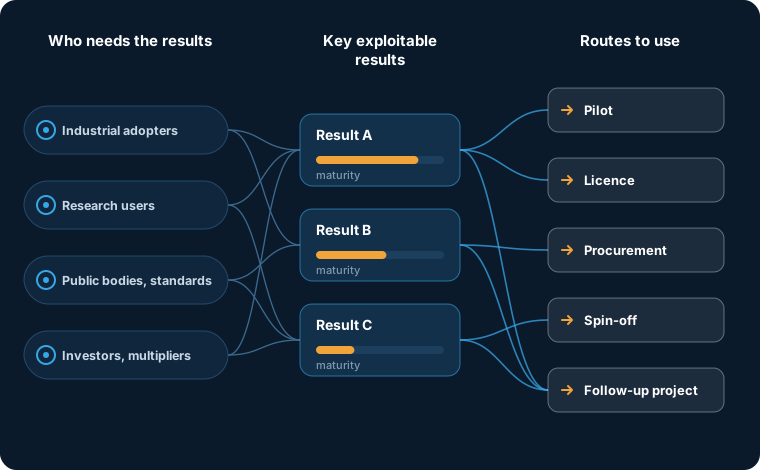
Key exploitable results

From the people who need a result to the route that brings it into use

Indicators measure use and adoption, not only impressions: interviews held, pilots agreed, licences discussed, follow-up projects prepared.

Diagram: stakeholder groups (industrial adopters, research users, public bodies and standards, investors and multipliers) linked to key exploitable results with their maturity, and to routes to use: pilot, licence, procurement, spin-off, follow-up project.

Cooperation

How JCP can contribute to a consortium

JCP can work as a defined supplier or, where the consortium and call justify it, as a project participant with a bounded task or work package. Its role, effort, deliverables and relationship with any related company are disclosed and costed separately. Proposal-development consultancy is not charged to a future grant.

  • Senior people with defined responsibilities and availability
  • Work in English, French and German; outreach in the languages of your user groups
  • Industrial outreach in Switzerland and neighbouring countries, built on long-standing business-development work
  • Transparent reporting, including on results with limited market potential

JCP has not yet led a work package in a Horizon Europe project. Its directly evidenced experience is research communication, spin-off commercialisation and industrial business development; any proposed role is bounded and costed separately.

Swiss participation

Switzerland in Horizon Europe

Switzerland officially became associated to Horizon Europe on 10 November 2025, with retroactive application from 1 January 2025. Swiss participation remains subject to the conditions of each call, including any specific restrictions.

Interreg participation follows Swiss federal and cantonal rules. Erasmus+ association is planned from 2027. We check eligibility call by call. European Commission: Switzerland. Status checked: 5 October 2026.

Partners from outside Europe? As consortium architect, JCP helps organisations from China, India, the Gulf and Africa assess whether and how they can contribute to European projects. Consortium architect →

Applied AI and software work is done by technical partners such as Artabel AG, a related company in Schindellegi that takes part in EU projects in its own right. Where both are in the same consortium, their tasks and budgets are separate and the relationship is declared.